


Flexible packaging has become the preferred format for food, beverage, pet care, and consumer goods brands worldwide. Among the most popular formats, stand up pouches combine shelf presence, barrier protection, and convenient closure options in a single lightweight package. For brands sourcing these pouches at scale, selecting the right stand up pouch manufacturer is a decision that directly affects product quality, shelf life, and brand perception.
A capable manufacturer does more than produce pouches to specification. The right partner brings material expertise, consistent print quality, reliable lead times, and documented quality control processes that reduce the risk of costly supply disruptions. This guide examines the criteria that separate dependable manufacturers from the rest, helping procurement teams make informed decisions when evaluating potential suppliers.
A stand up pouch manufacturer must deliver pouches that meet exact specifications for material structure, dimensions, print quality, and functional features. Beyond the physical product, a reliable manufacturer provides clear communication throughout the production cycle, from artwork approval to shipping documentation. Transparency in reporting production status, addressing technical questions, and handling revisions signals a partner who values long-term relationships over single transactions.
The manufacturer should also offer guidance on material selection based on the product being packaged. Different products require different barrier properties, and an experienced manufacturer will recommend the appropriate film structures whether the contents are dry goods, liquids, oily foods, or products requiring extended shelf life. This consultative approach distinguishes a manufacturer invested in customer success from one simply processing orders.
Stand up pouches are typically multi-layer structures engineered to provide specific barrier properties against moisture, oxygen, light, and aroma. Common material combinations include PET/PE for general purpose packaging, PA/PE for products requiring higher oxygen barrier, and PET/AL/PE for maximum protection against light and gas transmission. For products needing transparency, CPP/PE and BOPP/PE structures offer clear windows while maintaining reasonable barrier performance.
Advanced barrier materials such as EVOH can be incorporated into structures to achieve near-aluminum foil oxygen barrier levels while maintaining transparency. Aluminum foil remains the gold standard for products requiring maximum shelf life, as it blocks virtually all light, moisture, and gas transmission. The manufacturer should be able to explain the performance characteristics of each material combination and help buyers select the structure that matches their product requirements and shelf life targets.
Print quality directly affects how consumers perceive a brand on the retail shelf. A capable stand up pouch manufacturer offers multiple printing methods including rotogravure for high-volume runs with consistent color reproduction, flexographic printing for shorter runs and cost efficiency, and digital printing for low-quantity orders or prototype sampling. Each method has distinct advantages in terms of run length economics, color range, and turnaround speed.
Color matching capabilities matter equally. The manufacturer should support CMYK process printing, spot color and Pantone matching, and a range of finish options including matte, gloss, soft-touch, metallic, and holographic effects. Value-added techniques such as spot UV and hot foil stamping can differentiate a product on shelf. Buyers should request print samples to evaluate color accuracy, registration precision, and finish consistency before committing to a production run.
Functional features transform a basic pouch into a user-friendly package. Zippers provide resealability that extends product freshness after opening, a feature consumers increasingly expect in food and pet food packaging. Spout and cap fitments enable controlled pouring for liquid products, while degassing valves release carbon dioxide from freshly roasted coffee without allowing oxygen to enter the pouch.
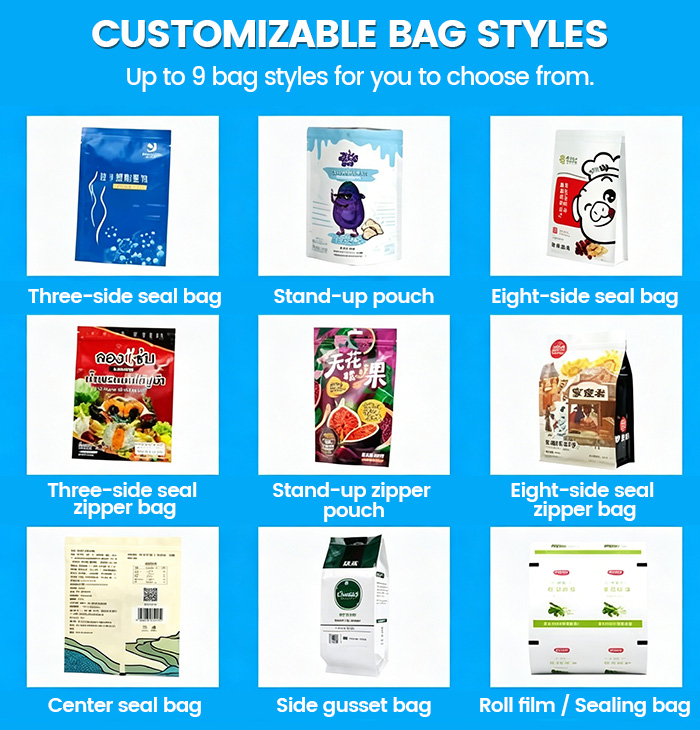
Additional features include tear notches for easy opening, hang holes for peg-board display, die-cut handles for carrying convenience, and clear windows that let consumers see the product inside. Flat and block bottom structures create stable shelf presentation, while side gussets expand capacity without increasing the footprint. A manufacturer worth partnering with should offer all of these features and be able to integrate multiple features into a single pouch design without compromising structural integrity.
Quality control separates professional manufacturers from casual producers. A stand up pouch manufacturer should maintain an ISO 9001 quality control system that governs every stage of production, from incoming material inspection to finished goods testing. Incoming inspection verifies that raw films meet specification for thickness, coefficient of friction, and optical properties before they enter production.
In-process control monitors print registration, lamination strength, and seal parameters during manufacturing. Laboratory testing should include seal strength testing, leak testing, moisture vapor transmission rate (MVTR) and oxygen vapor transmission rate (OVTR) measurement, color delta verification against approved standards, and migration testing for food contact compliance. Finished goods inspection confirms that pouches meet dimensional tolerances, seal integrity, and visual quality criteria before shipment. Full traceability from raw material lot to finished pouch enables rapid root cause analysis if any issue arises. Third-party inspection should be welcomed and supported.
Minimum order quantities and lead times vary based on pouch complexity and customization level. For custom-printed stand up pouches, typical MOQ ranges from 1,000 to 5,000 units for simple designs with standard material structures. Multi-color printing and complex structures involving foil layers, zippers, or spouts generally require 5,000 to 10,000 units minimum. Stock formats may be available in smaller quantities for brands testing a new product or format.
Production lead time typically runs 15 to 25 working days after artwork approval, depending on material availability, print complexity, and order volume. Shipping adds another 7 to 20 days depending on destination and shipping method. Buyers should plan their procurement timelines to account for artwork revision cycles, sample approval, production, and transit. A manufacturer that provides realistic lead time estimates and meets them consistently builds trust that supports long-term supply relationships.
Manufacturers exporting to international markets must provide complete and accurate documentation to ensure smooth customs clearance. Standard export documents include commercial invoice, packing list, bill of lading, certificate of origin, and material safety data sheets where applicable. For food contact packaging, documentation of material compliance with international food contact safety standards may be required by destination country regulations.
Shipping terms such as EXW, FOB, CIF, and DDP give buyers flexibility in choosing their preferred level of logistics involvement. A manufacturer experienced in exporting to 40 or more countries understands the documentation requirements of different markets and can help buyers navigate customs regulations specific to their destination. Container loading optimization is another value-add that experienced manufacturers provide, maximizing pallet density to reduce per-unit shipping costs.
Sustainability has moved from a marketing differentiator to a procurement requirement for many brands. A forward-thinking stand up pouch manufacturer should offer mono-material recyclable PE and PP structures that simplify recycling by eliminating mixed material layers. These structures approach the barrier performance of traditional multi-material laminates while enabling recyclability through existing polyolefin recycling streams.
Biodegradable and compostable options provide alternatives for brands targeting end-of-life sustainability goals. These materials break down under specific composting conditions, reducing landfill contribution. While barrier performance and shelf life may differ from conventional structures, ongoing material development continues to narrow this gap. Buyers should discuss their sustainability objectives with manufacturers early in the specification process to identify the material options that balance environmental goals with product protection requirements.
Certain warning signs should prompt buyers to conduct additional due diligence before committing to a manufacturer. Vague answers about quality control processes, reluctance to provide production samples, and inability to specify material structures or barrier performance data suggest a manufacturer may lack technical depth. Quotes significantly below market rates often indicate compromises in material quality, print consistency, or production standards that will surface as defects or failures after delivery.
Communication patterns also reveal much about a manufacturer. Slow or inconsistent responses during the quotation phase typically worsen after an order is placed. A manufacturer unwilling to discuss quality testing protocols, material certifications, or third-party inspection arrangements may be hiding gaps in their quality system. Buyers should also verify production capabilities by requesting facility photos, equipment lists, or arranging a virtual factory tour to confirm that the manufacturer possesses the equipment and capacity they claim.
Shenlong Packaging Products Co., Ltd. operates a 30,000 m² factory in Shenzhen Industrial Park, serving brands in 40+ countries across five continents. Founded in 1998, the company maintains an ISO 9001 quality control system with comprehensive testing protocols from incoming inspection through finished goods verification. The production team includes experienced technicians and senior engineers who guide material selection, structural design, and print specification for each project.
The company offers the full range of material structures, printing methods, and functional features discussed in this guide, including mono-material recyclable and biodegradable options. With documented lead times, flexible shipping terms, and complete export documentation, the company provides the transparency and technical capability that procurement teams need when evaluating a stand up pouch manufacturer for long-term partnership.
Selecting a stand up pouch manufacturer requires evaluating multiple factors that extend beyond price. Material expertise, printing capabilities, functional feature options, quality control systems, and export experience all contribute to a successful packaging supply relationship. Brands that assess these criteria systematically reduce the risk of quality issues, delivery delays, and shelf-life failures that can damage both products and reputation.
The evaluation process should include sample requests, quality documentation review, and open communication about technical requirements. Manufacturers that welcome scrutiny and provide detailed, evidence-backed answers demonstrate the transparency and technical competence that distinguish reliable production partners.
For brands seeking a manufacturer with decades of production experience, comprehensive quality systems, and global export capabilities, the criteria outlined in this guide provide a practical framework for making an informed decision that supports product success in competitive retail environments.
MOQ for custom-printed stand up pouches typically ranges from 1,000 to 5,000 units for simple designs with standard material structures. Multi-color printing, complex structures with foil or zippers, and specialty finishes generally require 5,000 to 10,000 units minimum. Stock formats may be available in smaller quantities for testing purposes.
Standard production lead time runs 15 to 25 working days after artwork approval, depending on material availability, print complexity, and order volume. Shipping to international destinations adds 7 to 20 days depending on the shipping method and destination port.
A comprehensive quality program includes seal strength testing, leak testing, MVTR and OVTR measurement, color delta verification, migration testing for food contact compliance, and finished goods inspection for dimensional accuracy and visual quality. All stages should be documented under an ISO 9001 quality control system.
Yes, mono-material recyclable PE and PP structures are available that simplify recycling by using a single polymer family. These structures approach the barrier performance of traditional multi-material laminates while enabling recyclability through existing polyolefin recycling streams. Biodegradable and compostable options are also available.
Manufacturers experienced in international trade typically offer EXW, FOB, CIF, and DDP terms, giving buyers flexibility in managing their logistics. Complete export documentation including commercial invoice, packing list, bill of lading, and certificate of origin is provided to ensure smooth customs clearance.
Yes, a manufacturer with a transparent quality system should welcome and support third-party inspection. Full traceability from raw material lot numbers to finished pouches enables inspectors to verify quality at any stage of production. Arrangements should be coordinated during the order confirmation process.

