


Food and home brands rarely fail on the product itself; they fail when the bag leaks, tears, fades, or arrives late in the wrong specification. Choosing an OEM packaging bags manufacturer therefore means weighing more than unit price: material suitability for food contact, print quality and colour consistency, bag construction and sealing strength, minimum order flexibility, and the supplier’s ability to repeat the same result order after order. This article ranks five options against those criteria, so buyers can compare like with like instead of relying on samples alone.
Each option that follows is assessed on the same basis — what it does well, where it is limited, and which type of food or home brand it fits best — so a buyer sourcing stand-up pouches, flat bags, or custom-printed retail packaging can shortlist quickly and ask sharper questions before committing to tooling or a first production run. The final section then turns those comparisons into a practical choice: which manufacturer to approach first for a new launch, for a high-volume staple, and for a brand-led redesign where appearance matters as much as protection.
Rank a format by product risk first, not by appearance. A powder that cakes, a snack that goes stale and a liquid that leaks fail for different reasons, so barrier, seal strength and base stability must outrank print finish in the first screen. Ask for fill weight, density, moisture sensitivity and shelf life before comparing prices.
Then test fit with filling and retail handling. Check whether the pouch runs on existing filling lines, whether the base stays upright when filled, and whether the closure survives repeated opening. A zipper that fails, a handle that tears under load, or a spout that drips damages repeat purchase faster than dull print.
Finally compare total landed cost and proof, not unit price alone. Request samples filled with the real product, plus drop and seal evidence and clear minimum order terms. A format earns top rank only when barrier, structure, line compatibility and verified samples align.
Five formats cover most food, pet and laundry briefs, and they rank differently because the failure mode differs. Stand-up zipper pouches lead for snacks and pet snacks, flat-bottom pouches lead for sugar and dense dry foods, block-bottom handle bags lead for heavy laundry powder, spout pouches lead for liquids, and side-gusset pouches suit bulk dry goods where cost and line speed matter most.
All five sit within flexible and composite plastic packaging bags, so the choice is not material family but construction, closure and base. An OEM Packaging Bags Manufacturer should be judged on whether the laminate, seal and base match the fill, not on catalogue size alone. A light snack pouch and a 5-litre liquid pouch share a category, not a specification.
Use the ranking below as a shortlist, then confirm the winner with filled samples, drop and seal checks, and a trial run on the filling line.
Verdict: the best retail format for snacks, pet snacks and dry foods where resealability drives repeat use. The stand-up base gives a front face, the zipper lets buyers open and close the pack without a clip, and the laminate protects crispness and aroma between uses. For snacks and pet treats, that combination of shelf presence and convenience is difficult to beat.
The trade-off is weight and barrier limit. A stand-up zipper pouch suits light to medium fills, not dense multi-kilogram packs that need a flat or block bottom for stability. Zipper alignment, seal contamination from crumbs or powder, and puncture from sharp contents are the failure points, so buyers should check zipper pull, seal strength and drop performance with the fill before ordering in volume.
Choose this format for retail snacks, pet snacks and dry foods up to a typical medium weight, and confirm size, zipper type and print finish from filled samples.
Verdict: the strongest choice for retail sugar and dry foods where caking, moisture uptake and loss of freshness decide shelf life. The three-side-seal, flat-bottom construction uses multi-layer co-extruded laminates, with print, middle barrier and inner sealant layers working to limit oxygen, moisture and odour transfer while forming a hermetic heat seal.
Food-contact compliance is the deciding check. The pouch is stated to comply with food-contact safety standards, naming FDA and EU 10/2011, and buyers should request documentation tied to the film supplied. Before bulk ordering, verify thickness, tensile strength, dart-drop puncture resistance, tear propagation and seal strength, then confirm free-flowing granules after stacking and storage trials.
Choose this format for 400g, 500g and 1kg retail sugar and dry foods, with CMYK print, matte, glossy or soft-touch finishes, tear notches, hang holes and resealable zippers where the pack and filling line allow. It suits automated filling and shelf display, but confirm size against product density.
Verdict: this format earns its place when family-size laundry powder needs to stand upright, carry comfortably and survive retail handling. The multi-layer laminated structure puts print outside, strength and barrier in the middle, and a heat-seal layer inside, so moisture and dust stay out while powder stays free-flowing. The block bottom folds into a flat base that spreads weight evenly and gives a wide front face for branding, fragrance claims and certification marks where the brand holds them.
Test it with the real fill before committing. Ask for drop and handle-pull tests at full weight, seal-strength and dust-leakage checks, and moisture-barrier trials after stacking and transport simulation. Watch the handle cut for tearing, the bottom corners for splitting, and the print for scuffing. The trade-off is cost and complexity against a plain stand-up pouch or woven sack: block-bottom bags suit premium retail packs, while lighter packs or bulk handling often justify a simpler format.
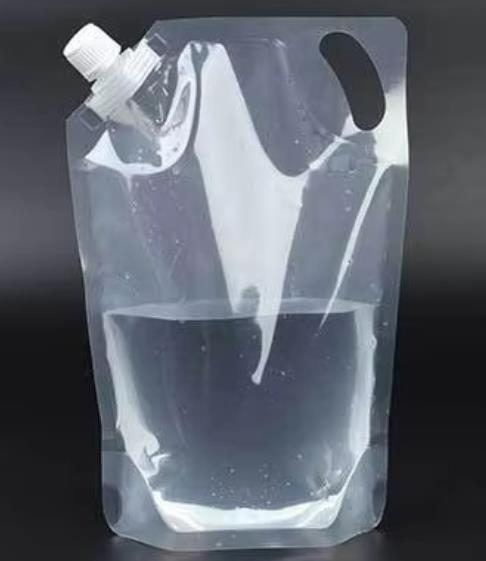
Verdict: this pouch is the practical choice for 1–5 litre liquid refills where a rigid bottle adds weight, cost and empty-storage volume. Multi-layer barrier laminates provide chemical resistance, leak-proof integrity and moisture and oxygen protection, with print and handling strength outside, a barrier layer in the middle and a compatible heat-seal layer inside. The reinforced integrated handle distributes the full load, while the wide-mouth screw-on spout, heat-sealed into the pouch, allows controlled pouring, dispensing and refilling.
Check compatibility before ordering in volume. Test the actual liquid for viscosity, pH, surfactants and fragrance, then run seal and spout-leak tests, drop and compression trials, handle-pull checks, cap torque and resealability checks. Compared with rigid bottles, these flexible and composite plastic packaging bags ship lighter when empty and present a larger printable face, but they demand tighter filling control and stronger spout sealing. They suit laundry detergent and fabric disinfectant refills, household cleaning solutions and institutional packs.
Verdict: woven bags and roll film earn their place where volume, line speed and handling strength matter more than a premium retail face. Woven laminated sacks carry dense dry goods with strong tear and puncture resistance, while roll film feeds form-fill-seal lines without pre-made pouch handling. For sugar and other granular dry foods, a co-extruded laminate can combine seal strength with puncture resistance that a single resin cannot provide, and a flat, stable base helps stacking and display after filling.
Specify roll film against the machine, not the catalogue alone. Confirm web width, thickness consistency, seal temperature window and print registration, then run filling, seal-strength and drop trials at line speed. Woven sacks suit bulk handling and heavier packs; roll film suits portioned retail formats, including typically 400g, 500g and 1kg packs, where automation and shelf presentation must work together.
Start with a sample built to the exact specification when assessing an OEM Packaging Bags Manufacturer, not a generic swatch. Request the proposed laminate, size, handle or spout, finish and print, then fill it with the real product and test load, seal, barrier and handling. Ask what documentation supports the construction, how artwork will be placed, and what minimum order quantity applies. A free sample kit helps compare print and structure, but only a filled sample proves performance.
Place a first order and agree the checks in writing. Confirm size tolerances, seal strength, barrier claims, drop and handle performance, print colour and scratch resistance, plus packing, labelling and delivery terms before production starts. Keep one approved sample as the reference for incoming inspection, and record any change to film, spout, handle or artwork. That sequence limits rework, protects shelf life and gives a clear basis for scaling from trial packs to family-size or bulk orders.
Choosing an OEM packaging bags manufacturer is less about the lowest unit price than about matching structure, material, print quality and supply reliability to a food or home product. The five options reviewed here differ in where they add value: some suit short runs and frequent artwork changes, others suit high-volume food lines where barrier performance, seal strength and consistent sizing matter most. Compare those trade-offs against shelf life, filling method and retail presentation, so the chosen bag performs during packing, transport and storage as well as it looks on shelf.
Before ordering, request samples in the exact size and material you plan to use, confirm printing, closure and minimum order quantity in writing, and test the bags on your own filling line. If you need support from specification through production, discuss your product, volume and delivery schedule with Shenlong Packaging Products Co., Ltd. and request a structured quotation.
Start with the intended product, filling method, shelf life and storage conditions, then check whether the manufacturer can supply the bag structure, size, closure and printing that match those needs. Ask for samples made to the same specification, confirm food contact suitability for food use, and review lead time, repeat order consistency and communication before committing to volume production.
Compare artwork reproduction, colour consistency, print area, and how the design performs on the chosen material and finish. Request printed samples rather than digital proofs alone, and check text legibility, logo placement, and resistance to scuffing during handling. Confirm who supplies artwork files, what file format is preferred, and how colour approval is recorded before production begins.
Provide the bag type, dimensions, material, thickness, closure, printing details, and quantity for each size or design. State the product to be packed, the filling method, the destination, and the required delivery date. Clear information allows the manufacturer to price accurately, identify suitable materials, and highlight any specification that may affect production time or cost.
Test samples with the actual product, using the same filling equipment, sealing settings, and storage conditions planned for production. Check seal strength, closure function, size, print quality, and whether the bag protects the product during handling and transport. Record any faults, share photographs and measurements with the manufacturer, and confirm corrections before approving the final specification.
Yes, in many cases one manufacturer can supply both, provided each bag is specified separately for its product, use, and handling requirements. Food packaging needs careful attention to product protection and food contact suitability, while home products may prioritise appearance, size, and closure. Separate specifications prevent a design suited to one product being applied incorrectly to another.


